


Overview & Concepts
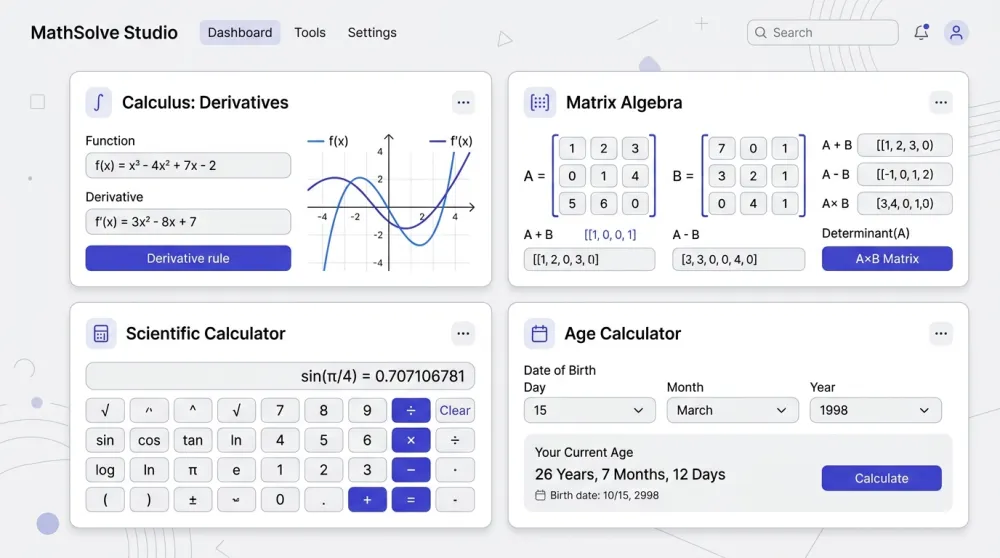
CalcSolver is a free online calculator built for students, engineers, and anyone who needs fast, accurate answers with full working steps — not just a final number. Whether you're checking basic arithmetic, solving an algebraic equation, or working through a calculus problem, our tools show every step so you can learn the method, not just copy the result.
At its core, a calculator applies a defined sequence of operations to inputs and returns an output. The reliability of that output depends on two things: correctly interpreting the expression (using the standard order of operations) and applying the right formula or algorithm for the problem type. Our Free Online Calculator handles everyday arithmetic, percentages, and scientific functions, while dedicated tools like the Calculus Solver and Equation Solver handle more advanced work such as derivatives, integrals, and multi-variable equations.
Step-by-Step Mathematical Method
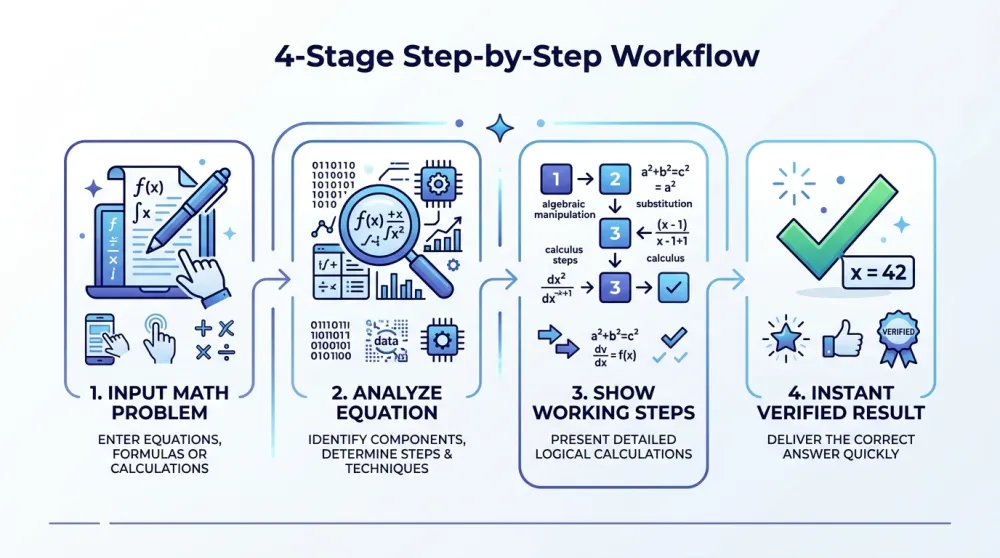
Good problem-solving follows a consistent method regardless of whether the task is basic arithmetic or advanced calculus. Below is the general approach CalcSolver's tools use internally, and one you can apply by hand as well.
General Problem-Solving Method
Follow these steps for any calculation, then verify with an online calculator:
For equations specifically, the goal is to isolate the variable on one side by applying the same operation to both sides — addition, subtraction, multiplication, division, or taking a root — until the variable stands alone. For calculus problems like derivatives, the method instead applies specific differentiation rules (power rule, product rule, chain rule) term by term. Our Equation Solver and Calculus Solver both display each of these intermediate steps automatically.
Worked Examples with Solutions
Here are three worked examples covering arithmetic order of operations, solving a quadratic equation, and finding a derivative — the three most common calculation types users bring to CalcSolver.
Example 1: Order of Operations (Arithmetic)
Evaluate: 3 + 4 × 2² − 6 ÷ 3
Example 2: Solving a Quadratic Equation
Solve: x² − 5x + 6 = 0
Example 3: Finding a Derivative
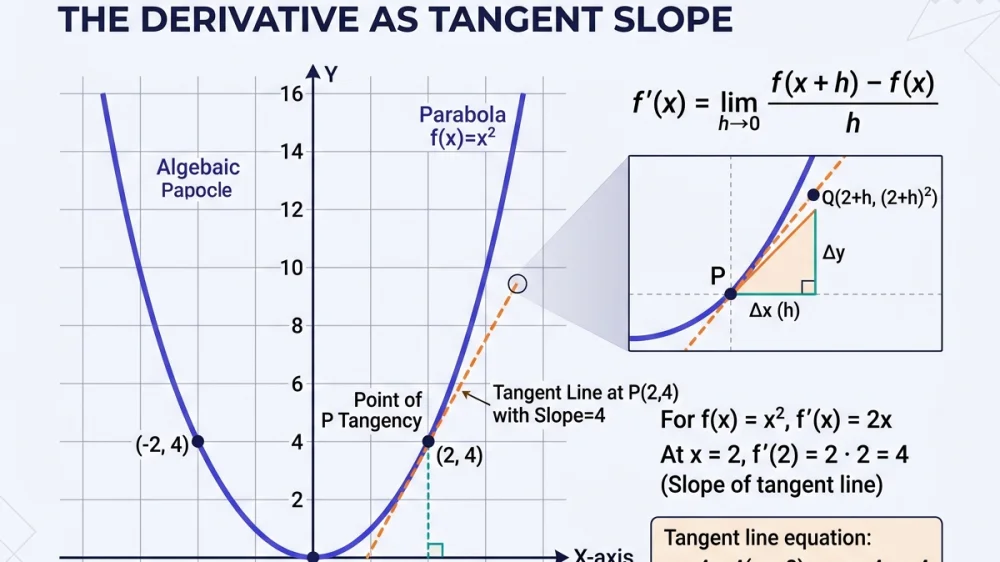
Differentiate: f(x) = x² + 3x − 4
Reference Values & Comparison Table
| Case / Method | Formula Used | Result |
|---|---|---|
| Arithmetic (PEMDAS) | 3 + 4 × 2² − 6 ÷ 3 | 17 |
| Quadratic Equation | x = (-b ± √(b² − 4ac)) / 2a | x = 2 or x = 3 |
| Derivative (Power Rule) | d/dx (xⁿ) = n·xⁿ⁻¹ | f'(x) = 2x + 3 |
| Percentage of a Number | (Percent ÷ 100) × Base | 15% of 200 = 30 |
Common Mistakes & Tips
Most calculation errors come from a small set of repeatable mistakes. Watch for the following when working by hand or checking a result with an online calculator:
- Ignoring order of operations: Multiplying before resolving an exponent, or adding before multiplying, changes the entire result.
- Sign errors in the quadratic formula: A misplaced negative sign in −b or inside the discriminant (b² − 4ac) is one of the most frequent algebra mistakes.
- Forgetting the constant term drops out: When differentiating, any constant (like −4 in Example 3) becomes 0 — it does not carry over.
- Not checking units: Especially in applied or engineering calculations, mismatched units (e.g., mixing centimeters and meters) lead to results that are numerically 'correct' but practically wrong.
- Rounding too early: Round only your final answer, not intermediate steps, to avoid compounding small errors.
A reliable habit is to solve the problem by hand first, then confirm the result using a trusted Free Online Calculator. For multi-step algebra, the Equation Solver shows each isolation step so you can spot exactly where a manual solution diverges. For derivatives, integrals, and limits, the Calculus Solver applies the same rules shown in Example 3 above, extended to more complex functions.